
Poker hand rankings: what beats what, from royal flush down
A 6 minute read · Updated 9 November 2026
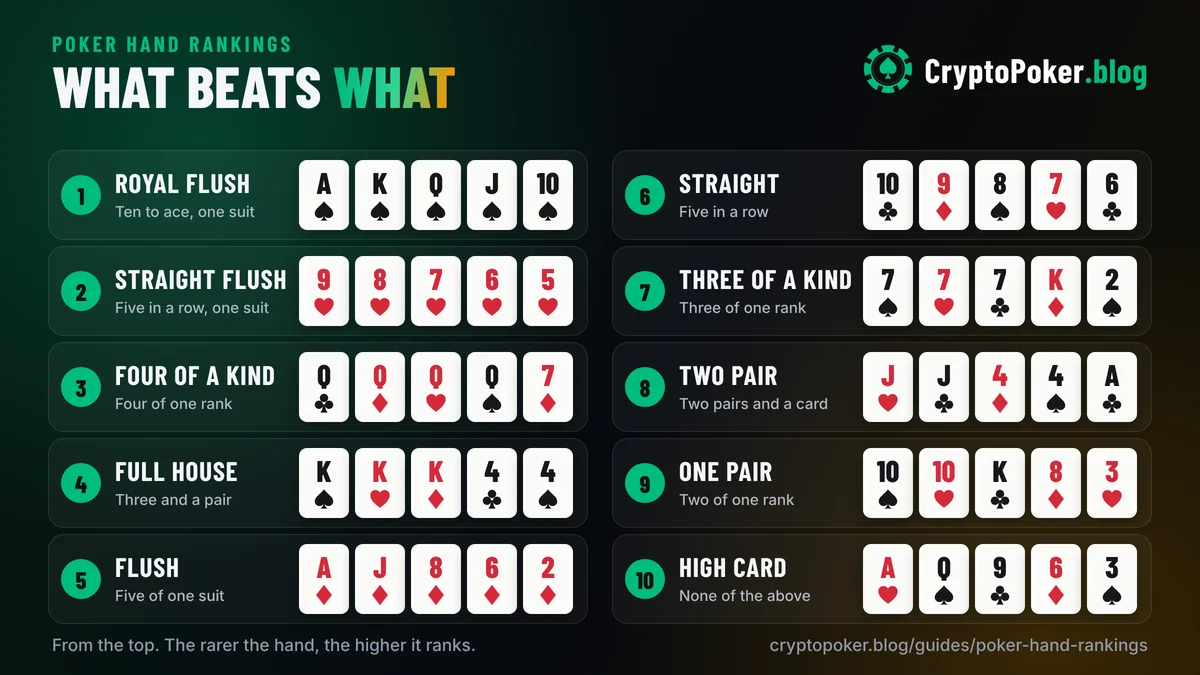
Hold'em and every kind of Omaha use the same ten hands in the same order. Here they are from the top, each with five example cards, then how often each one comes, how a tie between two hands of the same kind is settled, and four showdowns worked through.
The ten hands, from the top
A poker hand is always five cards. A hand higher on the list beats every hand below it, whatever cards are inside it: the smallest flush beats the biggest straight.
- 1. Royal flushTen, jack, queen, king and ace of one suit. It is the top straight flush, and nothing beats it.
- 2. Straight flushFive cards in a row, all of one suit. Between two of them, the higher top card wins.
- 3. Four of a kindAll four cards of one rank, also called quads. The fifth card decides only when both players use the same four.
- 4. Full houseThree of one rank and two of another, here kings full of fours. The three decide first, then the two.
- 5. FlushFive cards of one suit, not in a row. Between two flushes the highest card decides, then the next.
- 6. StraightFive cards in a row in mixed suits. The ace plays high, in ten to ace, or low, in ace to five.
- 7. Three of a kindThree cards of one rank. In Hold'em it is called a set when two of the three are in your hand, and trips when one is.
- 8. Two pairTwo cards of one rank, two of another and a fifth card. The top pair decides first, then the second pair, then the fifth card.
- 9. One pairTwo cards of one rank and three side cards, which decide a tie in order from the top.
- 10. High cardNone of the above. The highest card plays, then the next, down to the fifth.
The chart at the top of this page puts all ten on one picture, to keep on your phone.
How often each hand comes
| Hand | Five-card hands | With seven cards |
|---|---|---|
| Royal flush | 4 | 0.003%, 1 in 30,940 |
| Straight flush | 36 | 0.028%, 1 in 3,591 |
| Four of a kind | 624 | 0.17%, 1 in 595 |
| Full house | 3,744 | 2.6%, 1 in 39 |
| Flush | 5,108 | 3.0%, 1 in 33 |
| Straight | 10,200 | 4.6%, 1 in 22 |
| Three of a kind | 54,912 | 4.8%, 1 in 21 |
| Two pair | 123,552 | 23.5%, 1 in 4.3 |
| One pair | 1,098,240 | 43.8%, 1 in 2.3 |
| High card | 1,302,540 | 17.4%, 1 in 5.7 |
The middle column counts every set of five cards a deck can deal, 2,598,960 in all, and that is where the order comes from: the rarer the hand, the higher it ranks. The right column is what a Hold'em player sees when a hand runs to the river: the best five of seven cards, your two and the board's five, counted over all 133,784,560 sets of seven.
With seven cards, one pair and two pair come more often than no pair at all, and the best five make a flush about once in 33 times. The order still follows five cards, so high card stays at the bottom. We counted both columns with a program that goes through every hand, and the counts agree with Wikipedia's poker probability tables.
When two hands are the same kind
Most showdowns are two hands of the same kind, and the rules for those are short. Only five cards ever count, the higher card decides from the first one that differs, and suits never decide.
- Straights and straight flushes: the higher top card wins. Ten to ace is the highest straight. Ace to five, called the wheel, is the lowest, with the five as its top card.
- Four of a kind: the higher four win. When both players use the same four from the board, the fifth card decides.
- Full house: the three of a kind decides, then the pair. Kings full of fours beat queens full of aces.
- Flush: the highest card decides, then the second, down to the fifth.
- Three of a kind: the higher three win, then the two side cards in turn.
- Two pair: the top pair, then the second pair, then the fifth card.
- One pair: the pair, then the three side cards from the top.
- High card: all five cards from the top, until one differs.
A card that is not part of the pair, the two pair or the three of a kind but still counts toward the five is called the kicker. When the five cards match by rank the pot is split, even if one player holds a better sixth card or more cards of the suit.
Four showdowns, worked through
The kicker decides. Both players have a pair of kings:
- Board
- Player 1
- Player 2
Player 1 wins. Both make a pair of kings with the jack and the nine from the board, and the third side card decides: the ace beats the queen.
The board plays. Neither player can beat the five cards on the table:
- Board
- Player 1
- Player 2
The pot is split. The best five for both is the board itself, two pair with the ace as the fifth card. The king in Player 1's hand does not count, because only five cards play.
One card makes a flush. With four hearts on the board, a single heart is enough in Hold'em:
- Board
- Player 1
- Player 2
Player 1 wins with an ace-high flush: the ace of hearts and four hearts from the board. Player 2 holds two hearts and still has the lower flush, king high, because flushes are compared card by card from the top.
The wheel is the lowest straight:
- Board
- Player 1
- Player 2
Player 2 wins. Player 1 has ace to five, a straight with the five as its top card. Player 2 has two to six, one card higher.
Mistakes to avoid
- Ranking a straight above a flush. The flush is higher, and the full house is higher again.
- Counting a sixth card. When two hands tie on five cards, a better sixth card in your hand does not help.
- Breaking a tie with suits. No suit ranks above another, so the same five ranks split the pot.
- Missing that the board plays. When the five cards on the table beat anything you can make, everyone still in shares the pot.
- Running a straight round the ace. Queen, king, ace, two, three is not a straight.
In Omaha, PLO5 and PLO6
The order of the hands is the same in Omaha with four, five or six cards. What changes is how you make one: exactly two of your cards and exactly three from the board. Four hearts on the board and one in your hand is not a flush, and four cards to a straight on the board need two of yours to make it. Omaha rules shows these hands with the cards, and the low hand of the Hi-Lo games, which has an order of its own.
Check yourself
The which hand wins tool takes any board and up to four hands, in Hold'em or Omaha, and names the winner with the five cards that play. The showdown trainer deals river hands for you to call yourself, and the glossary has the words: kicker, set, trips and the rest.
Where we play
Basepoker
It runs in the browser, and you can start with a deposit of $1.
Play on Basepoker18+ · Affiliate link · Play responsibly
WePlay
The tournaments have guarantees, and you can start with a deposit of $10.
Play on WePlay18+ · Affiliate link · Play responsibly
Questions
What is the order of poker hands from best to worst?
Royal flush, straight flush, four of a kind, full house, flush, straight, three of a kind, two pair, one pair and high card. A hand higher on the list beats every hand below it.
Does a flush beat a straight?
Yes. A flush, five cards of one suit, beats a straight, five cards in a row. A full house beats both.
What happens when two players have the same hand?
The higher cards decide, from the first one that differs. For two pair that is the top pair, then the second pair, then the fifth card. When all five cards match by rank the pot is split, because suits never decide.
Is the ace high or low in a straight?
Either. Ten to ace is the highest straight and ace to five the lowest, with the five as its top card. A straight cannot run round the ace, so queen, king, ace, two, three is not one.
How rare is a royal flush in Hold'em?
With seven cards, 4,324 of the 133,784,560 possible sets of seven hold one: about once in 30,940 hands that run to the river.
How many cards make a poker hand?
Five. In Hold'em you take the best five of your two cards and the five on the board. In Omaha you use exactly two of your cards and three from the board. A sixth card never counts.